

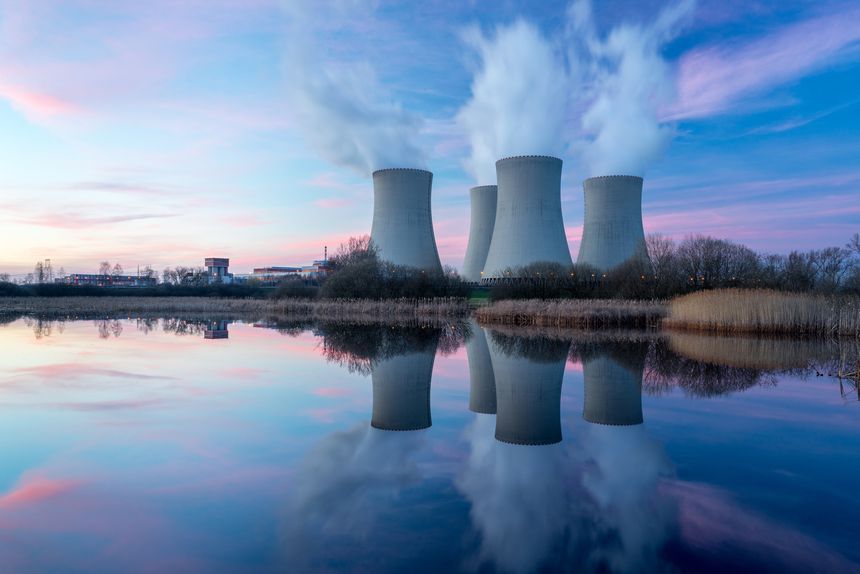
Warm rivers and low water levels are forcing nuclear power plants to reduce output across Europe. Over a year, the losses are minimal, but on critical days the loss of power has consequences for grids and prices.
Nuclear power plants suffer from low water levels because they must discharge a comparatively large amount of waste heat per kilowatt-hour generated. Only about one-third of the heat generated in a nuclear reactor is converted into electricity; the rest is released into the environment via the cooling system — often into rivers or the sea. But if the river is carrying little water, the waste heat is distributed over a smaller volume of water, and the water temperature rises faster.
Warm water also contains less oxygen, and legal temperature limits are in place to protect fish and other aquatic life. When operators throttle back a reactor in the summer, it is therefore usually not an emergency shutdown for reactor safety, but rather a measure to protect the local river life.
In critical situations, French authorities occasionally grant exemptions from these limits. In such cases, water bodies are monitored more closely, allowing the state-owned power company EdF to produce additional electricity in the short term.
A power plant with cooling towers draws significantly less water from the river and discharges considerably less heat directly into the water than a plant with an open cooling circuit. However, cooling towers do not make a nuclear power plant independent of weather conditions, as the Golfech plant demonstrates.
Located on the Garonne River, which is particularly warm in summer and frequently experiences low water levels, it is one of the most vulnerable sites, despite its cooling towers.
Meanwhile in Chooz on the Meuse River, the reactors had to be throttled back in 2020 despite the cooling towers, to avoid jeopardizing the drinking water supply in Belgium.
Further reading:
/Passle/69a9a5cfa0730380cf7deede/SearchServiceImages/2026-09-22-06-36-07-234-6ab221d71b7ce479992b778d.jpg)
/Passle/69a9a5cfa0730380cf7deede/SearchServiceImages/2026-09-16-15-56-47-236-6aaabc3fc03416ab10a86994.jpg)
